POPs waste is waste that contains persistent organic pollutants (POPs) at or above concentration limits set out in GOV.UK guidance. POPs are chemicals that do not break down in the environment, and the rules for POPs waste focus on destroying them rather than recycling them. This guide explains what POPs are, the regulations behind them, which wastes can contain them and how POPs waste must be managed. It is written for businesses and organisations that produce or hold waste and want a clear overview.
What are persistent organic pollutants?
The Department for Environment, Food and Rural Affairs (Defra) explains in its POPs policy information that POPs are organic chemical substances that meet the criteria of the UN Stockholm Convention on POPs. Those criteria are that the substances:
- are persistent, meaning they do not readily break down and stay in the environment for long periods
- bioaccumulate, building up in the tissue of humans and wildlife
- cause adverse effects or are toxic to human health or the environment
- can travel long distances in the environment, so they are found far from where they were used or produced
More than 30 POPs are listed in the Convention. They fall into three broad groups: pesticides, industrial chemicals, and unintentional by-products of combustion and some industrial and non-industrial processes.
The UK POPs regulations
As a party to the Stockholm Convention, the UK is required to ban or restrict the production, use, import and export of POPs. The Convention also requires stockpiles of POPs to be identified and managed, and waste containing POPs to be disposed of so that the POPs are destroyed or irreversibly transformed.
In Great Britain (England, Scotland and Wales), the Convention is implemented by the assimilated Regulation (EU) 2019/1021, as amended. In Northern Ireland, Regulation (EU) 2019/1021 applies directly under the Windsor Framework.
When waste counts as POPs waste
The Environment Agency's guidance on how to identify and classify waste containing POPs sets out a concentration limit table. If the POPs in a waste are at or above the limits in that table, the waste is known as POPs waste, and the POPs in it must be destroyed or irreversibly transformed.
The table covers substances such as:
- older pesticides, including aldrin, chlordane, DDT, dieldrin, endosulfan and lindane
- brominated flame retardants, including hexabromocyclododecane and several bromodiphenyl ethers
- polychlorinated biphenyls (PCBs)
- perfluorooctane sulfonic acid (PFOS) and perfluorooctanoic acid (PFOA), with separate limits for PFOA in firefighting foam mixtures
- short-chain chlorinated paraffins
- dioxins and furans
Many limits are set at 50mg per kg, but others are higher or much lower.
Under the waste duty of care, the guidance explains, the waste producer is responsible for knowing whether their waste contains POPs. Sources of information include the supplier or manufacturer of the material and laboratory analysis. Where POPs are present, they must be included in the description of the waste.
Which wastes can contain POPs?
Several common waste streams can contain POPs.
Upholstered domestic seating
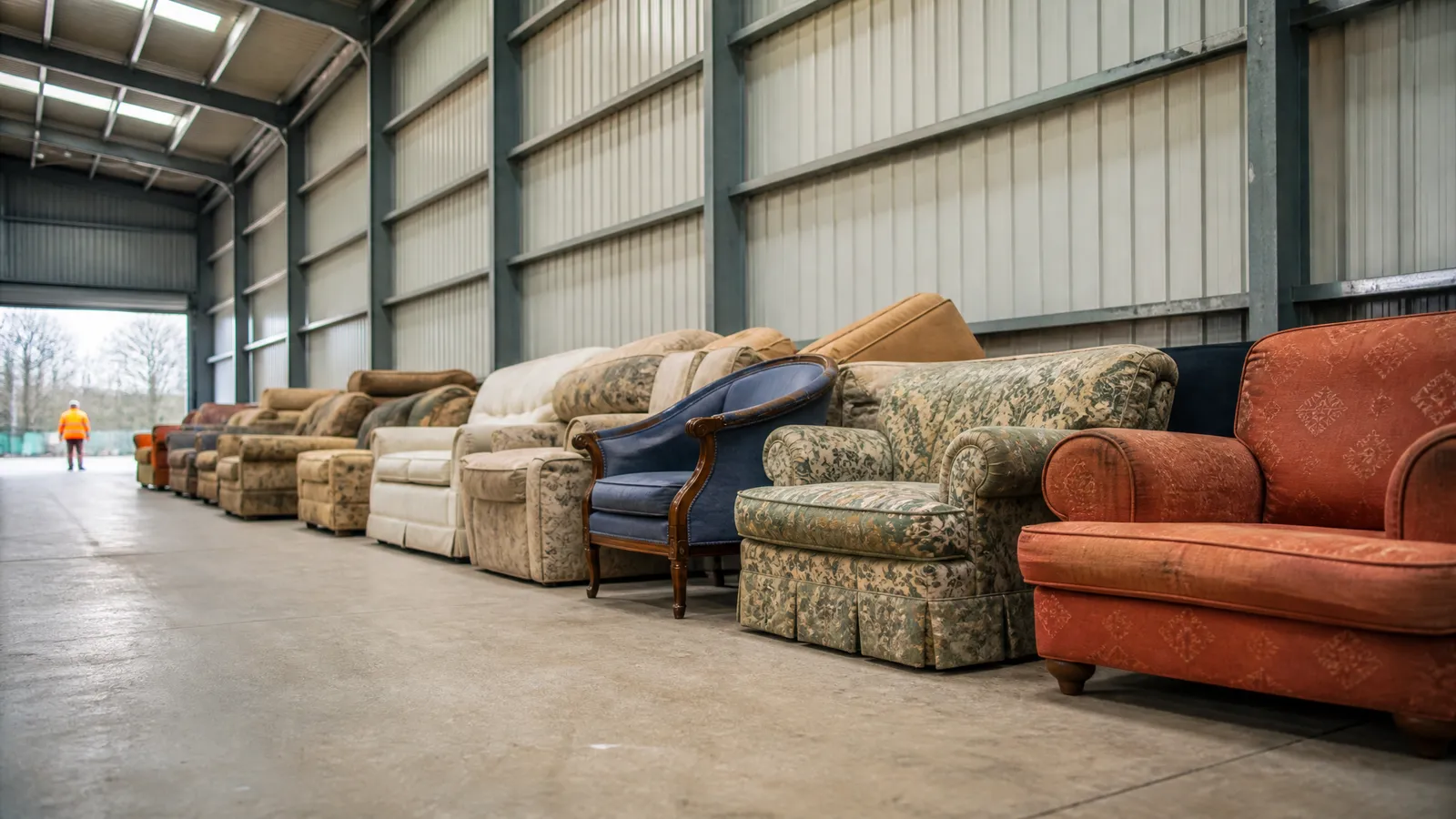
The Environment Agency guidance on waste upholstered domestic seating containing POPs explains that household-type seating from homes or businesses may contain POPs. Its examples include sofas, sofa beds, armchairs, recliner chairs, dining chairs, futons, bean bags and office chairs that are fire resistant to domestic standards.
The guidance names decabromodiphenyl ether (DecaBDE) as the most common POP in these items, usually on the back of covers and in the foam. Other brominated flame retardants may be present, and the chemicals can also contaminate lining and wadding.
This seating is described as "domestic seating waste containing POPs" and classified under List of Waste code 20 03 07. Waste under this code is classified as absolute non-hazardous, even though it may contain POPs. The guidance also notes that commercial seating is at particular risk of containing POPs.
Electrical equipment and plastics
Waste electrical and electronic equipment (WEEE) has its own GOV.UK guidance on POPs. The management guidance gives the example of plastics containing brominated flame retardant POPs, which can be separated from other plastics at suitably authorised treatment sites.
Pesticides, industrial chemicals and firefighting foams
Because the concentration table includes older pesticides, PCBs and fluorinated chemicals such as PFOS and PFOA, the POPs rules are not limited to furniture and electrical items. Collections of laboratory waste and liquid waste are planned around the information available on each item. If you are unsure whether a waste may contain POPs, speak to our team rather than guessing.
How POPs waste must be managed
The Environment Agency's guidance on how to manage waste containing POPs sets out the main rules.
Destruction or irreversible transformation
POPs waste must go to a suitably authorised disposal or recovery site that can completely destroy or irreversibly transform the POPs. The guidance lists the permitted methods as:
- D9, physico-chemical treatment such as chemical destruction
- D10, incineration on land
- R1, use as a fuel or other means of generating energy (not for material containing PCBs)
- R4, recycling or reclamation of metals and metal compounds, under the conditions in Annex V Part 1 of the POPs regulations
The method depends on the POP, the type of waste and other materials present.
Separation of POPs materials
A suitably authorised treatment plant can separate the items, components or materials that contain POPs from the rest of the waste. The separated POPs material must then be destroyed. The materials that do not contain POPs can be recycled or recovered.
No recycling or reuse
Waste containing POPs must not be recycled or reused, and the POPs must be destroyed. Recovery is allowed only where the process destroys the POP, for example incineration with energy recovery.
No mixing
The guidance also says that all reasonable steps must be taken to avoid mixing POPs waste with other waste during storage, collection and treatment. If mixing happens, the whole load is managed as POPs waste, and the POPs must be destroyed even if mixing has diluted them below the concentration limit.
Permanent storage in exceptional cases
In exceptional cases, a waste holder can apply to the Environment Agency to permanently store certain POPs wastes instead of destroying them. Permission is only given case by case.
POPs waste and hazardous waste
The POPs rules and the hazardous waste rules work side by side, and one does not replace the other. A waste can be absolute non-hazardous, as with domestic seating, and still be POPs waste that must be destroyed. Our guide to what hazardous waste is explains the hazardous side in more detail.
To discuss your waste, contact our team on 0845 366 9306 or email enquire@hazardousdisposal.co.uk.
This article is for general information only and does not constitute professional, legal or chemical advice. Waste producers are legally responsible for correctly classifying their waste. For guidance on your specific waste, please contact our team.