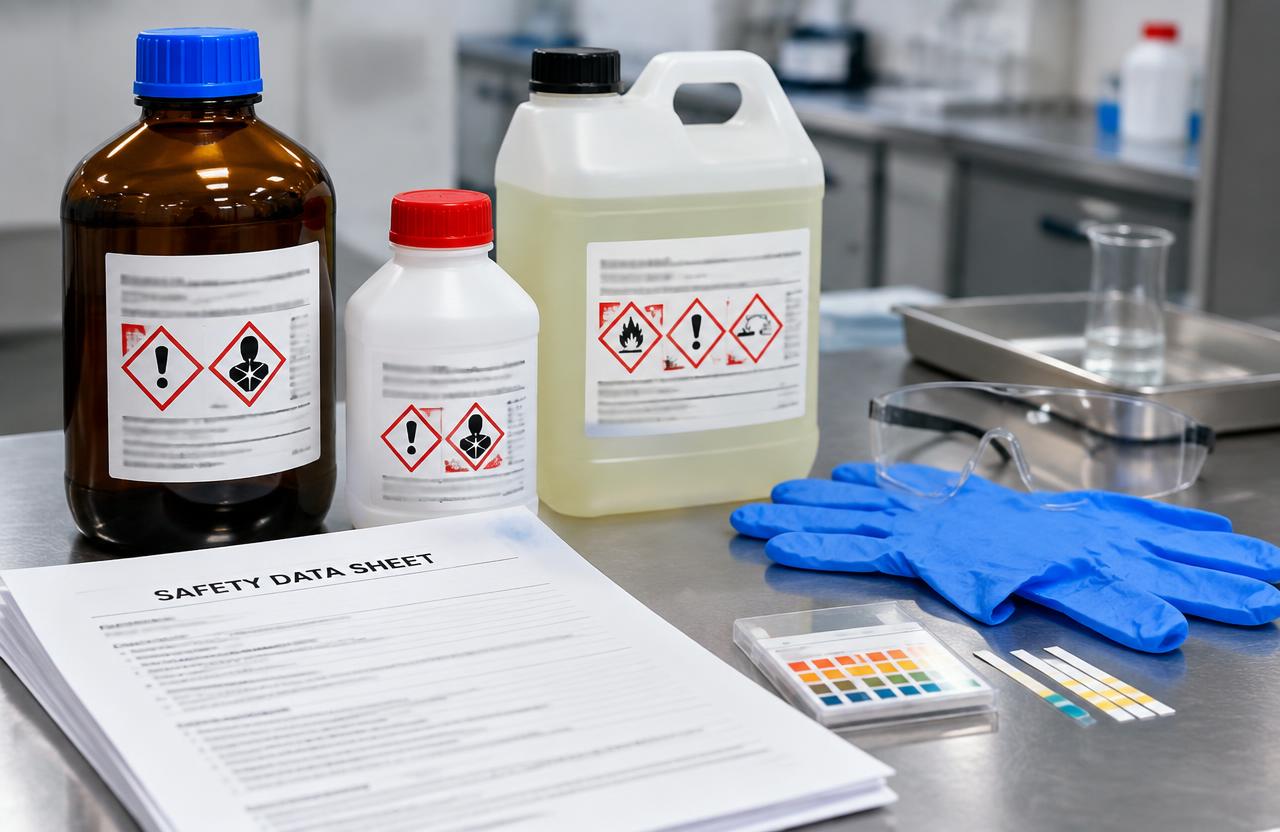
What is hazardous waste?
Hazardous waste is waste that contains substances or has properties that may make it harmful to human health or the environment. For UK businesses, identifying it involves the waste’s composition, how it arose and the hazardous properties set out in official classification guidance.
The GOV.UK hazardous waste guidance explains that waste holders must identify and classify hazardous waste before it is collected. This guide is for organisations that produce or hold chemical waste and need a clear overview of that process.
How hazardous waste is classified
Waste classification is based on evidence about the waste rather than its appearance alone. The product identity, the process that produced the waste, its composition and the relevant Safety Data Sheet (SDS) can all contribute to the description.
The Environment Agency’s Waste Classification Technical Guidance, known as WM3, is the principal technical reference for assessing waste and assigning a List of Waste code. These codes are also commonly called European Waste Catalogue (EWC) codes.
Some List of Waste entries are hazardous in all circumstances. Other entries are paired with a non-hazardous alternative, so the composition and hazardous properties determine which code applies.
Information used to describe chemical waste
A clear waste description normally brings together the product name, the process that created the waste, the composition where known, the SDS and an assigned EWC code. A product SDS describes the supplied product, while WM3 is used to assess the waste as it exists at the point of disposal.
The GOV.UK waste classification guide explains the information used to classify different types of waste. Where composition is uncertain, further evidence may be required before classification can be completed.
Examples of hazardous chemical waste
Commercial chemical waste can include solvents, laboratory reagents, oils, fuels, paints, treatment chemicals and contaminated packaging. Whether a particular stream is hazardous depends on its classification, not simply the product category or container size.
Typical collections include laboratory waste, solvent waste and waste oil. Each stream needs its own description and EWC code, even where several streams are collected during one visit.
Hazardous properties and product labels
WM3 sets out the hazardous properties used in waste assessment. These include properties associated with flammability, corrosivity, toxicity, oxidising potential and environmental hazards.
Product labels and hazard pictograms may provide useful supporting information, but they do not replace waste classification. Use, contamination and mixing can change the composition of a material after it was supplied.
Business responsibilities for hazardous waste
Under the waste duty of care, a business that produces waste remains responsible for taking reasonable steps to manage it correctly. This includes an accurate description and transfer only to an authorised person.
Hazardous waste movements require the relevant documentation. In England and Wales, a hazardous waste consignment note records the producer, carrier, waste description, quantity and receiving site. Requirements differ in Scotland, so the relevant national regulator’s rules apply.
Unknown and unidentified chemical waste
Chemical Disposal cannot quote for or collect unidentified or unknown chemicals. An approximate identity, such as the source, original product label or process from which the material arose, is needed before the waste can be reviewed.
Our team reviews the available information. If further identification is required, a testing or analysis service can be arranged only by agreement with the customer. Collection can be considered once the material has been identified and classified.
The identity of an unknown substance must not be investigated by smelling it, mixing it or carrying out informal tests. Information about exposure or emergencies is found on the SDS, and emergencies should be directed to the emergency services.
Information required before collection
Before Chemical Disposal can quote for or collect chemical waste, we require a copy of the Safety Data Sheet for each product or substance and an assigned EWC code for each waste stream. We also need the quantity, container type, collection address and photographs of the waste and labels.
We operate as licensed waste carriers. ADR drivers are used where required, and collected waste is transported to a licensed disposal site in our network. Chemical Disposal does not treat the waste.
Discuss your hazardous waste collection
For information about a specific collection, contact the Chemical Disposal team with the SDS and assigned EWC code for each waste stream. We can review the collection details and explain what further information is needed before a quote can be prepared.
This article is for general information only and does not constitute professional, legal or chemical advice. Waste producers are legally responsible for correctly classifying their waste. For guidance on your specific waste, please contact our team.